Building T3 Chat Clone — The Journey
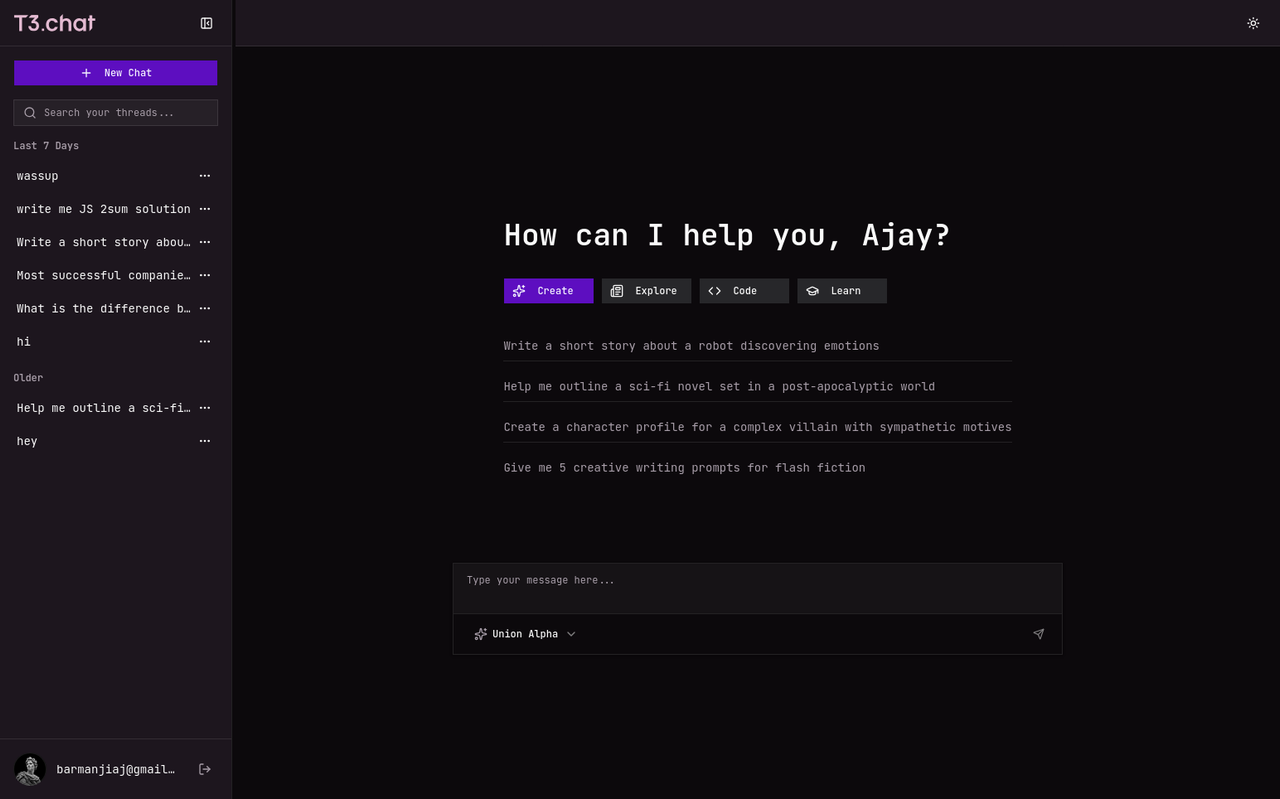
The Idea
T3 Chat caught my attention as a clean, multi-model AI chat interface. I wanted to rebuild it from scratch — not just as a UI clone, but as a fully functional product with real authentication, persistent chat history, streaming AI responses, and a production-ready deployment pipeline. The goal was to go deep on the full stack, not just the frontend. Made with the help of Suraj Jha
The Stack
| Layer | Choice |
|---|---|
| Framework | Next.js 16 (App Router, Turbopack) |
| Language | TypeScript |
| Database | PostgreSQL via Neon |
| ORM | Prisma 7 with driver adapters (@prisma/adapter-pg) |
| Auth | better-auth (GitHub + Google OAuth) |
| AI | OpenRouter via Vercel AI SDK |
| UI | shadcn/ui + Tailwind CSS 4 |
| State | TanStack React Query |
| Markdown | streamdown with syntax highlighting (Shiki) |
| Deployment | Vercel + Docker |
The Build — Phase by Phase
Phase 1: Foundation (Prisma + Auth)
Started with the database schema — User, Session, Account, Chat, Message models with cascade deletes. Connected Prisma to Neon PostgreSQL using the driver adapter pattern (PrismaPg with a pg.Pool). Set up better-auth with GitHub and Google OAuth providers, wired it into a catch-all Next.js route handler at /api/auth/[...all].
Route protection was done entirely through server components — no middleware. requireAuth() and requireUnAuth() live as server actions and get called in layout files. The (auth) route group renders the sign-in page for unauthenticated users, while (root) redirects to /sign-in if there's no session.
Phase 2: AI Integration
Connected OpenRouter as the AI provider. The chat endpoint streams responses token-by-token using the Vercel AI SDK's streamText() and returns them via Server-Sent Events. On completion, both the user message and AI response get persisted to Postgres.
A separate endpoint fetches available free models from OpenRouter's API and filters by prompt_price === 0 && completion_price === 0. The first free model auto-selects on new chats.
Phase 3: The UI
Built out the chat interface with a resizable sidebar (drag-to-resize, collapse to icons), chat history grouped by date, search functionality, and a model selector dropdown. Used shadcn/ui for base components and pulled in the AI SDK Elements registry for chat-specific components — message rendering, code blocks with Shiki syntax highlighting, mermaid diagram support, and reasoning/thinking displays.
Dark mode was handled by next-themes with system preference detection.
Phase 4: Deployment & Docker
Created a multi-stage Dockerfile (Node 20 Alpine, pnpm, Prisma generate, standalone Next.js output) and deployed to Vercel with output: "standalone".
Challenges We Faced
1. Prisma Client Generation on Vercel
Problem: The generated Prisma client lives at lib/generated/prisma/ (custom output path), and the entire directory is gitignored. On Vercel, the build failed with Module not found: Can't resolve './generated/prisma/client' because prisma generate was never run during the build.
Fix: Added prisma generate && before next build in the build script. Simple, but took a while to figure out why it worked locally but not on Vercel.
2. Shiki Version Conflict (Type Error)
Problem: @streamdown/code pinned to shiki@^3.19.0, while the project used shiki@^4.x. Two different BundledLanguage types existed — shiki v3 didn't have "actionscript" as a language, but v4 did. TypeScript threw a type mismatch error that blocked the entire build.
Fix: Added a pnpm.overrides in pnpm-workspace.yaml (pnpm v11 moved overrides out of package.json) to force all packages to use shiki@^4.4.3. One line, build passes.
3. CORS Issues with better-auth
Problem: GitHub and Google OAuth sign-in failed with CORS errors. The OPTIONS preflight to /api/auth/sign-in/social returned 404 — Next.js route handlers don't handle OPTIONS automatically.
Fix: Added CORS headers in next.config.ts specifically for /api/auth/:path* routes, locked to the actual production origin (not *). Also changed the authClient baseURL from a hardcoded http://localhost:3000 to use an env variable with an empty-string fallback for same-origin setups.
4. GitHub OAuth Redirect URI Mismatch
Problem: GitHub showed "redirect_uri is not associated with this application." The BETTER_AUTH_URL in .env was http://localhost:3000, but on Vercel the app runs at https://t3-chat-clone-five.vercel.app. The redirect URI sent to GitHub didn't match what was registered.
Fix: Set BETTER_AUTH_URL as a Vercel environment variable pointing to the production domain, and registered the full callback URL (https://t3-chat-clone-five.vercel.app/api/auth/callback/github) in GitHub OAuth app settings.
5. Prisma 7 + pg Pool Adapter
Problem: Prisma 7's driver adapter pattern (@prisma/adapter-pg + pg.Pool) is a newer approach that required wiring up the connection pool manually, creating the adapter, and passing it to PrismaClient. Not the typical PrismaClient() instantiation most tutorials show.
Fix: Ok the above text is written by AI coz its kinda generic, but this issue boy-oh-boy, it was gut wrenching. So for some unknown reasons i decided why not just in the middle of my development cycle, upgrade prisma to newer prisma-8. WHICH IS SHIT, the docs suck, the AI in their page suck, the prisma-8 suck. Its so hard to workaround, they removed prisma studio or idk where it is, prisma migrate - No its a migration plan, now you gotta make a contract to database. It looked cool from outside, but when i wrote a line of schema with @updateAt, it went bonkers it never let me do so. For some reason they have removed it and the LSP hasnt caught up to update and everything is a mess. So finally I went back to prisma 7, man I gotta use drizzle more.
What I Learned
- Prisma's custom output paths require explicit
prisma generatein CI/CD. Don't assume the platform handles it. - pnpm overrides are your friend for transitive dependency conflicts. Especially when two packages in the same ecosystem pin different major versions.
- better-auth is opinionated about CORS. If your client and server are on the same origin, don't set
baseURL— let it use relative URLs. - OAuth redirect URIs must match exactly. Even a protocol mismatch (
httpvshttps) breaks everything. - Server components as auth guards work well — no middleware needed for most apps. Layout-level
requireAuth()catches everything.
The Result
A fully functional multi-model AI chat application with GitHub/Google OAuth, persistent chat history, streaming responses, syntax highlighting, dark mode, and a resizable sidebar — deployed on Vercel with Docker support for self-hosting.